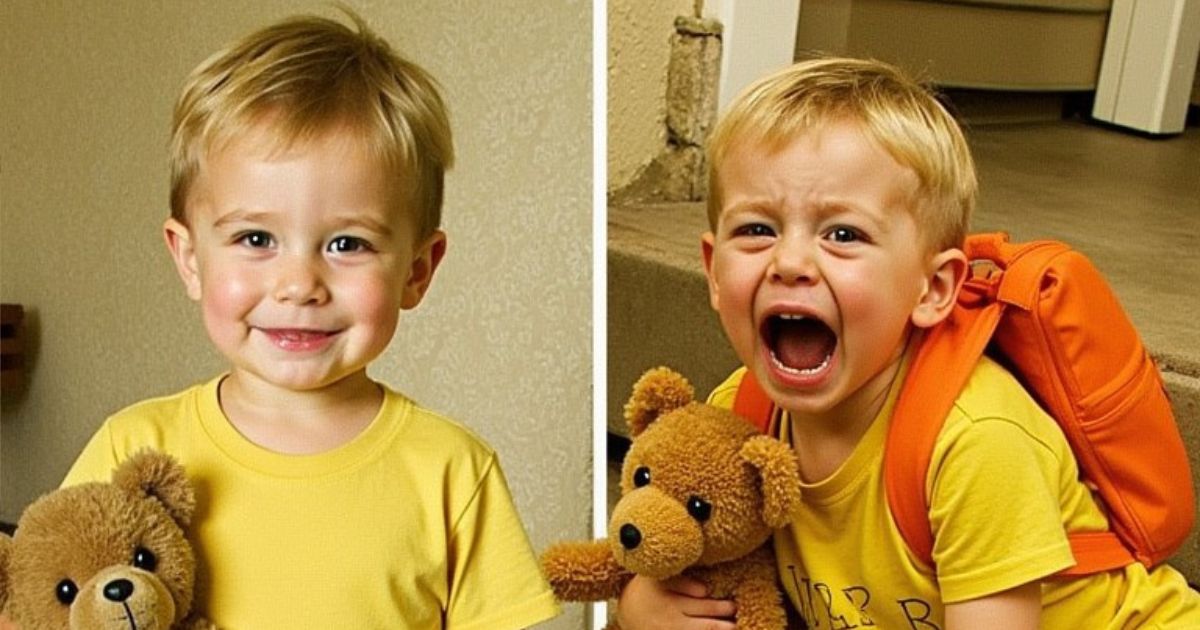
The Sudden Change
Until last week, mornings were the best part of our day. Johnny, my three-year-old, would wake up smiling, pack his tiny dinosaur backpack, and rush to the door before I could even finish my coffee. He loved daycare: the songs, the toys, the friends.
Then Monday came.
He clung to my leg and sobbed, his voice breaking:
“No, Mommy, no! Don’t make me go!”
I thought it was a fluke. Maybe he hadn’t slept well. But it happened again the next day. And the next. By Thursday, it wasn’t whining anymore. It was fear. His hands trembled as he begged me to stay.

When I called his pediatrician, she reassured me: “That’s normal separation anxiety. It comes and goes at this age.”
But something inside me said this wasn’t just separation. This was terror.
The Clue in His Voice
By Friday morning, my nerves were stretched thin. I was late for work, running on caffeine and guilt, and Johnny refused to get dressed.
I snapped. “Johnny, enough! You’re going to daycare!”
He froze. Not angry, not stubborn, just… terrified.
I knelt and pulled him close, feeling his little heart pounding against my chest. “Sweetheart, tell Mommy what’s wrong. Why don’t you want to go?”
He whispered, shaking:
“No lunch. Please, Mommy… no lunch.”
I felt my stomach drop.

Lunch? It didn’t make sense. Johnny loved snack time. Why would lunch scare him?
That night, I couldn’t sleep. My mind kept replaying his words. No lunch.
The next morning, I decided I wasn’t leaving anything to chance.
What I Saw Through the Glass
On Monday, I told Johnny everything would be okay and that I’d pick him up early. He nodded, hesitant but trusting me.
Around 11:15 a.m., just before lunch, I parked near the daycare and walked toward the building. Parents weren’t allowed inside during meal hours, but there was a viewing window beside the cafeteria — a small glass panel where you could peek in.
I found my son almost immediately. He was sitting alone at a tiny blue table. All the other kids had trays of food, laughing and chatting. Johnny’s tray was empty.

A daycare worker, a woman I recognized with her hair in a tight bun, stood over him, frowning. I couldn’t hear the words, but her tone was sharp, her gestures impatient. When Johnny reached for a paper cup that had fallen, she snatched it away, tossed it in the trash, and walked off.
He looked down, tears sliding silently down his face.
I felt a chill crawl up my spine.
Instinct took over. I pulled out my phone and recorded a few seconds through the glass — shaky, silent footage, just enough to capture the scene. Then I went inside.
The Confrontation
A staff member tried to block my way, but I brushed past. “What’s happening here?” I demanded.
The woman with the bun stiffened. Johnny looked up, saw me, and ran straight into my arms.
The worker stammered, “He threw his drink. We were teaching him not to waste food.”
I stared at her. “By not feeding him?”

The daycare director came rushing in, flustered. I showed her the short clip on my phone — just a few seconds, but enough. She looked horrified. “This is not how we discipline children,” she said quietly.
By the end of the day, the staff member in question was suspended.
The Fallout
I didn’t tell many people at first, but word spread fast. Within a week, two other parents approached me privately, both said their kids had been dreading lunch too.
A few filed complaints. Two weeks later, a state inspector visited the center.
The final report confirmed what I’d feared: several employees had been using “meal deprivation” as punishment for “noncompliant behavior.”
My stomach turned reading those words. Johnny wasn’t misbehaving. He was being conditioned through hunger.
The Aftermath
Johnny’s in a new daycare now. It’s smaller, warmer, the kind of place that welcomes parents inside at any hour. He still asks me sometimes, “Mommy, is lunch okay here?”
Every time, I smile and say, “Yes, baby. Lunch is okay here.”
And though it’s been months, I still think about that Friday morning, about how easy it would have been to brush it off as “a phase.”
Sometimes, a parent’s instinct is the only alarm that rings before something breaks.
All images are for illustrative purposes only.